Governor calls school leaders ‘hysterical’ as many districts submit deficit budgets
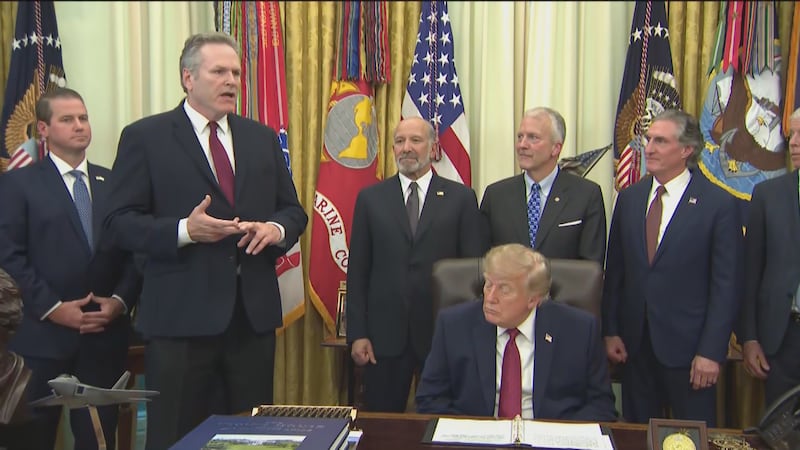
ANCHORAGE, Alaska (KTUU) - Right as school district budgets are due to the state, Gov. Mike Dunleavy called education leaders “hysterical” as school leaders finalize budgets they characterize as including steep deficits and gouged reserves from several funding threats.
Superintendents for weeks have been saying they have had to make impossible budget choices to ensure student success and safety.
“Rest assured that regardless of what you hear from your local school district, class sizes will be reasonable, teachers will teach, and school activities will continue,” Dunleavy said. “It is also important to understand that while the legislature and governor determine overall education funding, local school districts decide how that funding is spent. Some make better decisions about how to spend those resources than others.”
Those “local school districts” have told Alaska’s News Source they’ve needed to make “impossible” decisions to keep the lights on in the face of the governor’s cuts.
Some implied keeping the lights on was a far ask.
“It’s really hard as a community to have those public education impacts to close schools and to have to move students around, to have to move staff around, to have to cut teachers,” Rebecca Hurbi, Executive Director of Communications for the Fairbanks North-Star Borough School District, told Alaska’s News Source in June.
“Those are all really devastating. It’s been devastating to our community.”
“If a school loses diesel generators to keep that school warm, we can’t replace that boiler if we don’t have money,” said Superintendent of Akiachak’s Yupiit School District Scott Ballard. “If we have to rebuild the boiler, we don’t have the money. If we need to improve our system for fire protection because it’s not up to code, we do not have the money to do that.”
Funding from the state government hasn’t been the only factor into their budget proposals, though, taking into account what school leaders say, there are multiple revenue threats from potential local restrictions and federal funding cuts.
Alaska’s News Source reached out to DEED to get more information on the budget auditing process and when budgets will need to be finalized and approved. They did not comment.
Education funding veto
Dunleavy line-item vetoed about $51 million in education funding on June 12 - funding which was incredibly contentious in its initial passage. Eventually lawmakers voted to override the governor’s vote. In the Tuesday press release, the governor called opposition to the veto of per student funding, known as the Base Student Allocation, “merely rhetoric.”
“The partial veto of the BSA increase was carefully considered and necessary given falling oil prices resulting in less funding available,” he said.
The special session includes “education reform” as a central piece for discussion, but the governor’s spokesperson says the bill’s contents will not be revealed until the first day of the session. That said, legislators are not eyeing his bill as much as they are the potential of another veto override.
To ensure his veto survives, though, spokesperson for the governor Jeff Turner confirmed Dunleavy has told the minority party to skip the first five days of the special session — the only days the legislature could override vetoes under Alaska statute.
It would take 45 lawmaker votes to override Dunleavy’s vetoes. If all 25 minority lawmakers skip, a line-item veto override is impossible.
Alaska’s News Source learned one essential minority member, Sen. James Kaufman, R-Anchorage, said he would return to the session and vote in favor of a veto override, like he did back when lawmakers overrode the initial veto.
Dunleavy has not commented publicly on the subject and has denied multiple attempts to be interviewed by Alaska’s News Source over the last several weeks.
Superintendents say the governor’s orders are “political gameplaying,” something majority members of the party said they also feel.
“It’s disheartening that the governor would not value our kids,” said Rod Morrison, superintendent of Thorne Bay’s Southeast Island School District. “I know he’s got his own personal agenda items, but unfortunately that hurts every kid in the state of Alaska when he decides not to fund schools.”
The session will assemble in Juneau Aug. 2. If votes were to be the same as the last veto override, proponents can only afford to lose a single vote to rebuke the governor’s veto.
Local funding rule proposal
On top of the funding cuts already compounding, the Alaska state school board has also been considering changing a rule limiting the amount of money cities and boroughs can use to fund schools in their districts, according to the Alaska Beacon.
Under the new rule, cities and boroughs that are at or near the amount they can donate, like Anchorage and Juneau, would have the invested funding reduced. The rule redefines the definition of “local contribution” to match the definition used by the Impact Aid program.
The Impact Aid program is a federal program under the U.S. Department of Education which is designed to assist local school districts that don’t benefit from lost property tax revenue due to federal property or increased expenses from enrollment of “federally connected children, including children living on Indian lands.”
“The magnitude of this emergency regulation passing could result in tens of millions of fewer dollars for students across the state,” Jharrett Bryantt, superintendent of the Anchorage School District, said while testifying against the rule.
Anchorage School Board Chair Carl Jacobs did not respond to a request for comment on Monday. The school district announced after a special meeting in June they face $4.3 million reduction in funding.
The rule was postponed back at the beginning of June and a 30-day public comment period opened. Board chair James Fields said he didn’t want the board to have “its integrity compromised by rash decisions.”
That comment period would have ended no later than July 4.
The board met July 1 but did not discuss the funding. They will reconvene for their regular quarterly meeting in October, according to the board’s schedule.
Alaska’s News Source reached out to DEED and the State Board of Education over the emergency regulation, information on the comment period and who submitted the rule for consideration. They did not comment.
Federal funding cuts
President Donald Trump long vowed to slash spending in the federal government, and on May 2, the president unveiled his budget detailing billions of dollars in education funding cuts.
One of those cuts, Migrant Education and Special Programs for Migrant Students, is slated to lose $428 million.
“These programs have not been proven effective, are extremely costly, and encourage ineligible non-citizens to access U.S. (Institutions of Higher Education), stripping resources from American students,” the cut’s description said.
Michael Lee, Superintendent of the Delta Greely School District, said in June he was able to secure a budget without cuts for the next year, even with the damage from the governor’s veto diminishing the amount in reserves. However, with the two compounding cuts (the governor’s and the presidents, if passed by Congress), Lee says he’s worried about what the school will look like in 2027.
“Our current concern is that with the federal cuts that will take effect in [fiscal year 2027] for many Title programs [such as Title 1C-Migrant Education], we will face a more significant budget shortfall in FY27,” Lee told Alaska’s News Source back in June. “We may be forced to implement cuts in FY27 if the legislature does not restore additional funding in January.”
In addition to the president’s proposed cuts, the Trump administration also withheld $6 billion in federal education funding to states and local schools meant to be available July 1, Politico reported.
On Monday, 24 states and the District of Columbia filed a lawsuit against Secretary of Education Linda McMahon and Trump, saying the education funding freeze is “is contrary to law, arbitrary and capricious, and unconstitutional.”
Alaska was not mentioned in the suit.
The lawsuit also follows the President’s vows and actions dedicated toward dismantling the Department of Education.
See a spelling or grammar error? Report it to web@ktuu.com
Copyright 2025 KTUU. All rights reserved.