2026 midterms set new record for political ad spending
WASHINGTON (Gray DC) - The 2026 midterm elections have become the most expensive election cycle in U.S. history when it comes to political advertising, surpassing even the 2024 presidential election.
With Election Day less than a week away, an estimated $11.21 billion has been spent or reserved for political advertisements, according to the ad-tracking firm AdImpact.
That’s slightly more than the $11.2 billion spent during the entire 2024 election cycle and roughly $2.3 billion more than the 2022 midterms.
“It’s not just that a lot of money is being spent, it’s that it’s very expensive to advertise this late in the campaign,” said Todd Belt, a political management professor at George Washington University.
Some of the biggest spending has taken place in traditionally “red” states, where increasingly competitive Senate races have attracted hundreds of millions of dollars.
Texas now holds the record for the most expensive nonpresidential race in U.S. history, with more than $560 million in political advertising spending and reservations, according to AdImpact.
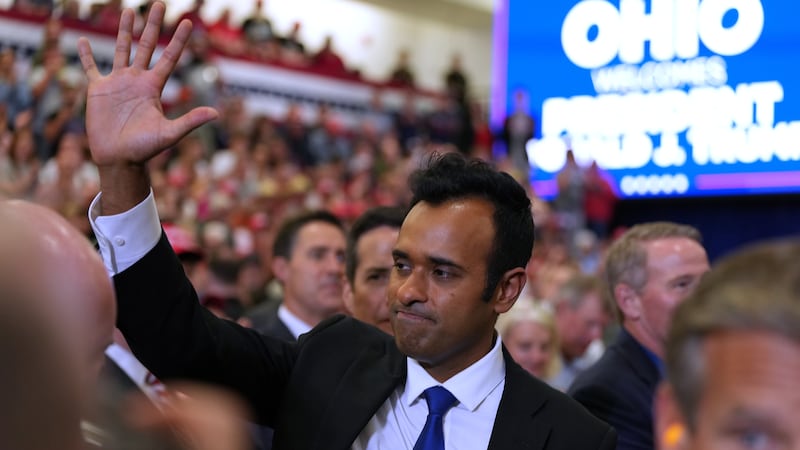
Ohio’s Senate race has also surpassed $500 million, making it one of only three nonpresidential races to reach that milestone. The third was Ohio’s 2024 Senate contest.
Republicans have maintained an advantage in political advertising, spending approximately $5.18 billion this election cycle, compared with $4.77 billion for Democrats, according to AdImpact.
The Republican National Committee has also emphasized its intention to deploy its available resources before Election Day.
“There’s no saving money for a rainy day. Whatever we can get that can be deployed is going to be deployed,” RNC chief of staff Mike Ambrosini told The New York Times.
Democrats, meanwhile, have pointed to grassroots fundraising as evidence of enthusiasm among their supporters.
“When you have hundreds of thousands of contributors who are giving 5, 10, 15 dollars, they’re very excited. That is one indicator of enthusiasm,” Democratic National Committee Chair Ken Martin said.
While both parties rely on smaller contributions, some of the largest financial commitments have come from billionaire donors.
Elon Musk has contributed nearly $450 million to Republican causes during the election cycle, according to Federal Election Commission.
By comparison, two of the largest Democratic megadonors, George Soros and Michael Bloomberg, have contributed approximately $102 million and $84 million, respectively.
Despite the Republican financial advantage, Belt told Gray Media’s Washington Bureau the election could offer a test of whether money or political messaging proves more influential.
“It’s almost a perfect natural experiment, where the Republicans have the money and the Democrats have the voice against the administration,” he said.
And while money alone may not determine the outcome, Belt said a lack of advertising could prove costly in close races.
“If you allow your side to go dark at the end of the campaign, you might miss out on a few of those voters and in a very close race, that could make all the difference,” he said.
Copyright 2026 Gray DC. All rights reserved.