Newly discovered species of dinosaur relative identified by UAF scientists
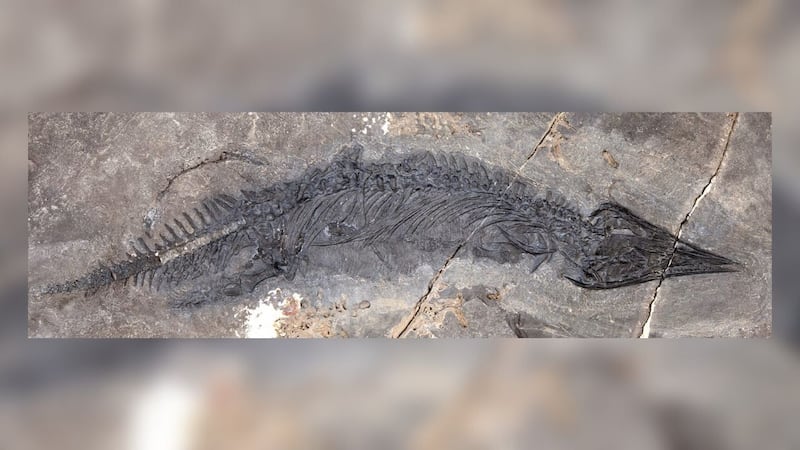
This fossil of Gunakadeit joseeae was found in Southeast Alaska. About two thirds of the tail had already eroded away when the fossil was discovered. (KTUU)
Nine years ago, scientists at University of Alaska Fairbanks discovered a fossil in Southeast Alaska which now has been identified as new species of thalattosaur, a marine reptile that lived more than 200 million years ago, and now we are finally getting a glimpse of what the fossil looks like.
Scientists found the fossil in the Keku Islands near the village of Kake back in 2011.
Jim Baichtal, a geologist with the U.S. Forest Service’s Tongass National Forest and his colleague Gene Primaky were in the area looking for fossils when they stumbled across the big find in rocks in the intertidal zone. The site is normally under water all but a few days a year when the extreme low tides hit.
In a paper published in the journal Scientific Reports, the new species, Gunakadeit joseeae, is the most complete thalattosaur ever found in North America.
According to a release from UAF, thalattosaurs were marine reptiles that lived more than 200 million years ago, during the mid to late Triassic Period, when their distant relatives — dinosaurs — were first emerging. They grew to lengths of up to 3-4 meters and lived in equatorial oceans worldwide until they died out near the end of the Triassic.
“Thalattosaurs were among the first groups of land-dwelling reptiles to re-adapt to life in the ocean,” said Neil Kelley of Vanderbilt University. “They thrived for tens of millions of years, but their fossils are relatively rare so this new specimen helps fill an important gap in the story of their evolution and eventual extinction.”
When scientists first made the discovery back in 2011, they had only days to get the fossil out of the area before tides rose again.
“We rock-sawed like crazy and managed to pull it out, but just barely,” said Patrick Druckenmiller, the paper’s lead author and director and earth sciences curator at the University of Alaska Museum of the North. “The water was lapping at the edge of the site.”
Over several years a fossil preparation specialist worked to clean up and ready the fossil to be studied.
A key characteristic scientists immediately took notice of was its skull.
“It was probably poking its pointy schnoz into cracks and crevices in coral reefs and feeding on soft-bodied critters,” Druckenmiller said. Its specialization may have been what ultimately led to its extinction. “We think these animals were highly specialized to feed in the shallow water environments, but when the sea levels dropped and food sources changed, they had nowhere to go.”
The name of the news species is special to Alaska.
According to the release, to honor the local culture and history, elders in Kake and representatives of Sealaska Corp. agreed the Tlingit name “Gunakadeit” would be appropriate.
Gunakadeit is a sea monster of Tlingit legend that brings good fortune to those who see it.
The second part of the new animal’s name, joseeae, recognizes Primaky’s mother, Joseé Michelle DeWaelheyns.
You can read the full press release
.